



The European Commission gave a response to a question from a Lithuanian MEP regarding whether ships belonging to the Alafouzos family transported Russian oil, despite sanctions, as Mononews media reports. According to the article, the Commission avoids giving clear answers and defers responsibility for implementing the measures to member states, leaving critical questions unanswered.
In its response to date, the Commission has not announced any new names of EU companies or individuals who will face immediate separate sanctions based on the question. Instead, it focuses on the broader context of measures already in place and being extended to limit the operation and economic role of the shadow fleet, the report says, adding:
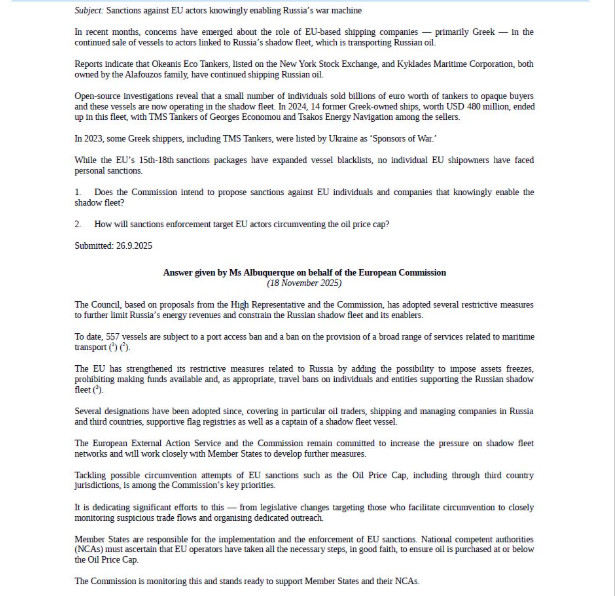
It is recalled that on September 26, 2025, written question E-003761/2025 was submitted to the European Parliament by Lithuanian MEP Petras Auštrevičius, a member of the Renew Europe political group, on the transport of Russian oil in circumvention of European Union sanctions via the so-called shadow fleet.
The question asked the European Commission to clarify whether it intends to consider imposing sanctions on European entities which, according to press and other reports, may be facilitating such shipments. In this context, reference is made, among others, to the shipping companies Okeanis Eco Tankers and Kyklades Maritime, which belong to the family of Yiannis Alafouzos.
The European Commission’s statement, published on November 18, 2025, does not directly respond to the allegations made by the MEP, but makes general references to sanctions. However, this can be interpreted as meaning that the Commission is investigating the case in depth and may reserve the right to respond to the allegations in the near future, once it has gathered more evidence.
The European Commission’s response is as follows:
The European Commission stated that the Council of the European Union, based on proposals from the High Representative and the Commission, has adopted a series of restrictive measures designed to further limit Russia’s energy revenues and curb the operations of the Russian “shadow fleet” and its supporters. To date, 557 vessels are subject to port entry bans and prohibitions on a wide range of shipping-related services.
The European Union has also reinforced its sanctions regime against Russia by introducing measures such as asset freezes, restrictions on the disposal of funds, and, where appropriate, travel bans on individuals and entities linked to the “shadow fleet.” These listings mainly target oil trading firms, shipping and management companies in Russia and third countries, supporting registries, and even a captain of a vessel associated with the shadow fleet.
The EU External Action Service and the Commission remain committed to intensifying pressure on these networks and will continue working closely with Member States to develop additional measures. Tackling efforts to circumvent EU sanctions—such as breaches of the oil price cap by third-country jurisdictions—remains one of the Commission’s top priorities.
The Commission is devoting substantial resources to this effort, ranging from legislative initiatives targeting those who facilitate circumvention, to close monitoring of suspicious trade flows, as well as organizing dedicated information and cooperation activities. Member States are responsible for enforcing EU sanctions, ensuring that operators act in good faith and purchase oil at or below the price cap. The Commission continues to monitor this process and stands ready to assist national authorities whenever necessary.
The question: (Question for written answer E-003761/2025)
The involvement of the listed company Oceanis Eco Tankers Kyklades Maritime Since the start of the conflict between Russia and Ukraine, and the sanctions that followed, there have been reports in the international press referring to the activities of the listed shipping company Okeanis Eco Tankers and the family company Kyklades Maritime, owned by Yiannis Alafouzos and his son Aristides Alafouzos. In fact, a relevant question has been submitted to the Commission by MEP Petras Auštrevičius. Question for written answer E-003761/2025).
According to reports in April 2025, evidence was revealed that vessels belonging to the Alafouzos family had transported cargo from Russian ports after the start of the Russian invasion of Ukraine, raising questions about whether the sanctions and restrictions imposed by the West on Russian energy were being fully complied with.
Furthermore, in October 2025, the MEP submitted a formal question to the European Commission, asking it to consider imposing sanctions on Okeanis Eco Tankers and Kyklades Maritime due to their links to the so- called "shadow fleet," which transports Russian oil.
According to reports in the Wall Street Journal and Greek media, vessels controlled by the Alafouzos family have sailed to Russian ports dozens of times since the start of the war and in several cases have transported Russian crude oil or cargoes originating from Russian ports.
The company has stated that it stopped transporting Russian oil through Okeanis Eco Tankers in 2023 following requests from investors, but the family continued to transport Russian oil with private ships. It should be noted that the CEO of Okeanis, Aristides Alafouzos, has publicly stated that the company does not rely on shipments and that cargoes from the Black Sea were mainly from the CPC terminal, which contains a large proportion of Kazakh oil, which is not subject to sanctions.
However, analysis of shipping data shows that Russian crude oil has also been transferred at times when Urals—the benchmark for Russian oil—was trading above the price cap, raising questions about whether this violates or circumvents sanctions.
Vessel approaches
It should be noted that, according to Vortexa data, vessels belonging to the Alafouzos family have made approximately 140 approaches to Russian ports since the start of the war in Ukraine. Of these, several involved the transport of Kazakh oil through Russian ports. In 2025, nine shipments of Russian crude oil have been made.
What Yiannis Alafouzos said
In mid-August 2022, Yiannis Alafouzos responded to critics of the transport of Russian oil by expressing his views on the matter. It is worth recalling them: During the conference call on the positive results of Okeanis Eco Tankers for the first half of 2022, G. Alafouzos stated that all major Western oil companies buy and transport oil from Russia.
“I don’t understand why there is all this hypocrisy about not going to Russia when everyone needs and transports Russian oil”; said G. Alafouzos.
In fact, in his message to TradeWinds, G. Alafouzos emphasizes:”The world’s energy balance is very tight, and Europe has not been able to break free from Russian crude oil and its products, as evidenced by the recent easing of EU sanctions. According to Bloomberg and the article A Storm Brews in Heating Oil” by Javier Blas), Russian exports to Europe are at pre-war levels in June and July.
“Incidentally” he added, “Europe is now buying diesel from non-EU countries at high prices, mainly from India, which comes from Russian crude sold at a discount on the market, exacerbating the European energy crisis and further undermining the EU’s competitiveness. “At the beginning of the war” explained G. Alafouzos, “we decided not to transport Russian oil. But then we saw that even the oil giants were taking Russian oil. We also saw the EU itself encouraging this by making it a little easier to insure ships”.
Tradewinds reported on May 17, 2024, that Aristides Alafouzos, in a presentation of the company’s financial results, stated that his company continues to outperform its competitors” and emphasized that “agreed freight rates from April to June were $75,900 per day for 82% of the days for VLCCs, and $60,800 per day for 57% of Suezmax capacity. This is 50% and 48% higher, respectively, compared to the freight rates of competing companies that have provided data to date”.
These divs raised questions among investors, who asked how they were achieved by the company’s management, while its competitors had lower freight rates and results.
Data on the shadow fleet
As part of its sanctions packages, the European Union has highlighted the so-called “shadow fleet” a large network of old tankers with an opaque ownership structure and insufficient insurance, used to circumvent sanctions and price caps on Russian oil. Part of these measures includes a blacklist of vessels that are prohibited from entering European ports or using EU services.
The European Parliament has also passed a resolution calling for stricter controls and sanctions against tankers exporting Russian oil in circumvention of sanctions, as well as their owners and operators. Increased monitoring, inspections, and the ability to impose sanctions on vessels and operators are also required.
According to TankerTrackers.com, the dark fleet consists of 1,480 active vessels, which can be divided into different groups based on their flag, size categories, etc.
Analyzing the dark fleet based on the flag of each vessel separately, we have the following list of the top 20:
Panama: 186 vessels
Russia: 184 vessels
Cameroon: 103 vessels
Iran: 98 vessels
Sierra Leone: 95 vessels
Comoros: 68 vessels
Gambia: 64 vessels
Guinea: 51 vessels
Curaçao: 50 vessels
Guyana: 50 vessels
Palau: 48 vessels
Oman: 37 vessels
Barbados: 35 vessels
Hong Kong: 33 vessels
Aruba: 27 vessels
Benin: 27 vessels
Liberia: 27 vessels
Marshall Islands: 27 vessels
Cook Islands: 20 vessels
North Korea: 18 vessels
In terms of the barrels transported by these vessels over the past year, we have the following list of the top ten:
Iran to China: 1,675,340 barrels per day
Russia to India: 992,930 barrels per day
Russia to China: 895,898 barrels per day
Venezuela to China: 638,054 barrels per day
Russia to unknown destination: 260,035 barrels per day
Iran to UAE: 120,041 barrels per day
Russia to Turkey: 114,775 barrels per day
Saudi Arabia to China: 74,647 barrels per day
Russia to Syria: 64,347 barrels per day
Kazakhstan to India: 52,788 barrels per day
Grouped by size category:
Handysize/Handymax: 633 vessels
Aframax: 366 vessels
VLCC/ULCC: 233 vessels
Suezmax: 151 vessels
Panamax: 97 vessels
Finally, grouping by year of construction:
2003: 151 vessels
2004: 143 vessels
2005: 143 vessels
2006: 118 vessels
2002: 99 vessels
2007: 89 vessels
2008: 84 vessels
2000: 81 vessels
2009: 69 vessels
2001: 65 vessels