

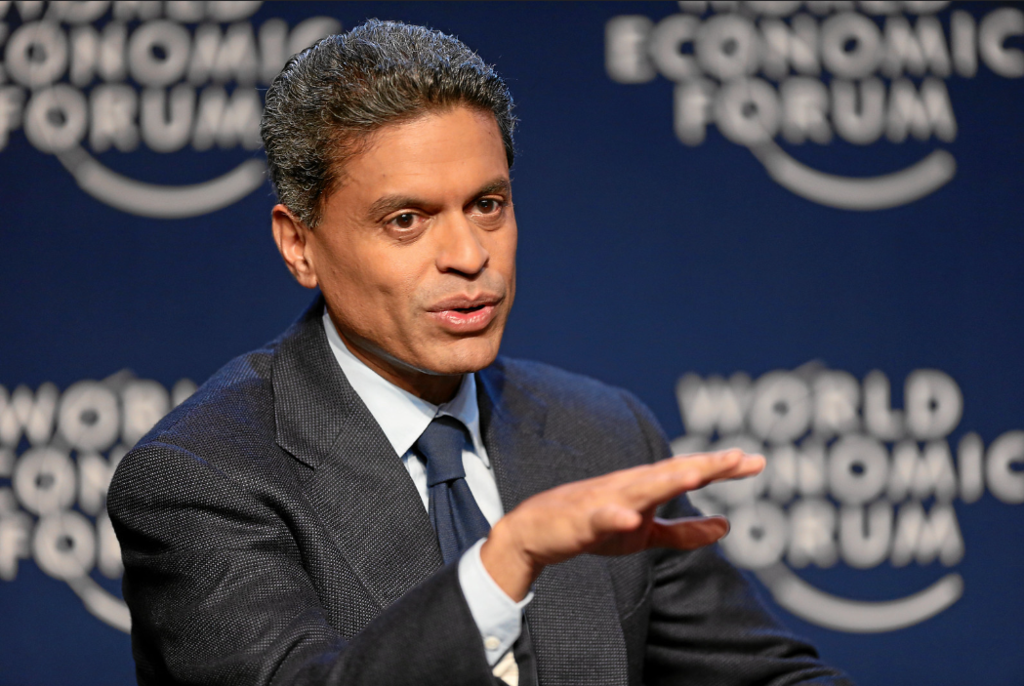


This is an extraordinary opportunity for Europe to become a global player, but the question is whether it can truly unite, whether it can adopt a coherent strategic policy away from nationalist rivalries said Fareed Zakaria, one of the most prominent political analysts and journalists worldwide in an interview with “Ta Nea”. His weekly international and domestic affairs program on CNN has featured interviews with Joe Biden, Barack Obama, Narendra Modi, Vladimir Putin, among many others, while his column for the “Washington Post” is among the longest-running for the newspaper. “Ta Nea” spoke with him via Zoom about Ukraine, Europe, the USA, Trump, his latest book “Age of Revolutions”.
You said that 2026 is a pivotal year for the fate of Ukraine and the fate of the Western alliance. Let’s talk about Ukraine first. What should we expect? Do you see any signs that are encouraging that the negotiations might lead to a deal soon?
On the ground there is actually a lot to be hopeful for. Putin has staked everything on this battle. He does not care how many soldiers he loses. And yet the Russians have barely gained 1% of territory in the last 18 months. The Ukrainians are absolutely heroically holding the ground. They have innovated technologically in brilliant ways. Their morale remains strong. The Europeans have completely stepped up and are fully funding not just the Ukrainian defence efforts, but Ukraine itself. The big challenge is that the United States under Trump is essentially trying to side with Russia to close out this conflict. Without it being blatantly obvious they are taking the Russian position on many of the negotiating issues and they put pressure on Zelensky. It’s the wrong approach politically and morally, but also because the Ukrainians are not going to simply surrender away their freedom, their independence, their sovereignty. It’s not going to work. Everything depends on whether the Trump administration realises that the better path to peace is to put more pressure on Russia and less pressure on Ukraine, get the Russians to understand that they are on a losing struggle. There is an obvious deal. Ukraine loses the territory it has lost. In return they must get absolutely secure security guarantees. I would prefer if they got some kind of guarantee from NATO, but if not, from the US and Europe. The path for success is absolutely watertight security guarantees, maybe with some European troops in Ukraine. The question is, can we get there.
Concerning the Western alliance what signs do you think are needed to understand whether it will survive?
The Western alliance is much stronger than people think. There’s no question that what Trump has done is damaging. Trump has fundamentally not understood the value and scope of the Western alliance, what it has done to stabilise the world and how much it’s benefited America. To the Trump administration and particularly to the MAGA kind of leaders like JD Vance, Europe is like addressing a woke Ivy League university. It contains all the values of liberalism gone too far that they don’t like. But Europe is not going to change its free speech laws because J.D. Vance wants to make a fancy speech about it. Those laws are in place for deep historical reasons in countries like Germany. Once you get past a certain amount of ideological point scoring and rhetorical bromides and assaults, you get to the practical question of where do you go. What the Trump administration will find, is that it’s better to do things with partners, to have the support of other countries, of other militaries. There will be less of the kind of dissolution of the alliance with one caveat. If the Trump administration really breaks with Europe on Ukraine. That will be a big problem.
But until the Trump administration comes to that realization where does Europe stand? The German Chancellor says that the world order has ceased to exist, that Germany should take responsibility. Could Germany become the leader of a new world order and of Europe?
This is an extraordinary moment and opportunity for Europe. Let’s imagine that Donald Trump didn’t exist. Europe is the second most dynamic economic area in the world after the United States. Europe already spends a great deal on defence, but it does not have much impact on the world because it’s not unified, it doesn’t have a strategic, coherent identity and policy. For the good of the West, of the liberal international order, of all the values it is important that Europe be a player and not a museum in the world. This is an opportunity for Europe to become a player. The question is, can Europe actually come together. Right now you hear a lot of rhetoric, but when you get to the reality of, say, defence spending, of, say, investing in air defences, we get back to the same nationalist rivalries. Your question is exactly right because you need a leader. Germany can play that role. Modern Germany is completely different from the Germany of the past. It understands that to lead today means you are doing it entirely by consensus with other countries. Germany has to do it. In Europe today only the Germans have money and they have a really powerful industrial base. Germany can create the kind of military industrial complex that the United States has. The challenge is not technical. The challenge is political. Europe has always stopped short of this kind of coherent strategic policy because policymakers want to retain the option of being in control of their own foreign and defence policy. You’re not going to change that completely, but on some crucial key areas you can do it. The model is trade. Imagine if they could do the same on defence.
Who benefits the most by the US economic policy, is it China? And who are the losers? Is the US a loser?
China has been the greatest beneficiary of the Trump administration’s policies without any question. The United States went from being the leader of a free trade ecosystem and alliance that included the richest, most powerful, most productive, most technologically advanced countries in the world, except for China, to having spent the last year creating divisions within that alliance. It’s completely self defeating. The Chinese have benefited, but they have not been able to create an alternative ecosystem. China’s close allies are basically North Korea, Iran, Russia, not exactly a galaxy of the world’s most productive and important countries. It’s a kind of a rogues’ gallery. But they are a very powerful adversary. China is dominating the green technology space and the world of advanced manufacturing. China produces one out of every two robots produced in the world. In AI, the US is ahead, but China is not far behind. In the third World everybody is using Chinese AI models. The Chinese are not trying to create a consumerist free market economy in which every person has maximum income. They are trying to produce an industrial economy that dominates in manufacturing, in frontier technologies, in the pharmaceutical and bio space, and they are succeeding.
With an unreliable US on one side and a highly competitive China on the other isn’t it difficult for Europe to navigate through?
It’s hard, there’s no question about it. But if Europe truly can reform, this is the second most dynamic economic area in the world after the United States. Twenty years ago the US and
Europe were comparable. In the last 20 years the US has taken off, Europe has stagnated. Two big mistakes. One, the disastrous experiment with austerity that Greece in part suffered because of it. Europe went after the 2008 crisis for austerity. The US did not. The US and the Eurozone were roughly the same size in 2008. US is now 50% larger. Second, we are in the midst of an information revolution and Europe has not played in that space. In the information space you need great scientific talent, engineers, venture capital and scale. You need billions of users. The US has engineers, venture capital and scale. China the same. Europe has great scientific talent, it has and can attract venture capital. The problem is scale. Europe is not actually a single market. Any tech entrepreneur will tell you, the reason I go to America is that in Europe, I am actually dealing with 27 markets, 27 regulators, 27 different local content laws. You can’t have scale if you’re 27 markets.
What’s the sentiment in the US of Trump’s economic policy?
The Supreme Court ruled tariffs unconstitutional, which they clearly are. I’m surprised that it wasn’t a 9.0 ruling, because the constitution is absolutely clear that this is a power that belongs to Congress. It’s a sad sign of how political the court is that three members thought otherwise. I’m always very careful when discussing macroeconomics, particularly when you’re talking about a country as large as the US, a $30 trillion economy. Many of the things Trump has done that are harmful, are actually not hugely consequential in the short term. 85% of the US market is a domestic market. The tariffs affect 50% of the economy and the effective tariff rates are much lower than what Trump advertises. The negative things he’s done, the tariffs, attacking the Federal Reserve, the politicisation of economics, all have longer term costs that don’t produce a crisis. On the other side Trump has been very effective at deregulating, making it much easier to build, to provide permits, licences. Oil prices have gone down this year, from about 80 (dollars a barrel) to about 60. That’s like a huge tax cut for every American. On net it does not surprise me that the US economy continues to do pretty well. The big question for the US economy is that it is essentially turned into one large bet on artificial intelligence. In the last year about 40% of the economic growth of the United States came from spending on artificial intelligence. If the revenues coming out of artificial intelligence are not large enough to sustain these hundreds of billions of dollars being spent that could be a moment of reckoning and that could cause a recession.
This is a crucial year, you have the midterm elections. Over the past years we have been saying polarisation in the US is increasing. Is there a fear that the elections might not be fair?
It’s a real fear. The Trump administration is trying without any question to tamper with a free and fair election. They are trying to suppress voters coming out in certain areas. They’re talking about taking over the voting systems in places. The irony is they actually don’t need to do this because the US is very polarised, as you say and even though Trump is not very popular now, if you look at the Senate the chance that the Democrats win in places like Iowa, Montana, Wyoming, all these small states is very low. So the Republicans start out with a huge advantage. They will probably lose the House, but not by a lot. So the reality is not that dramatically bad for Trump. He doesn’t need to engage in the kind of scary, undemocratic kind of policies he seems to be threatening to do. But it’s a sign of Trump’s basic temperament. Trump has no respect for laws, norms, ethics. If he wants to do something, he will just do. Demolishing the East Wing of the White House is a perfect metaphor for Trump. There are laws, rules, norms, there’s a matter of taste, none of it matters. He just demolishes it. Then he’s like, what are you going to do? I’ve already demolished it. You break the rules and then leave it to somebody else to div out what they’re going to do.
Which makes the life for the Democrats even more difficult.
The Democrats have a larger challenge. All the energy on the Democratic side comes from the far Left. But the polling is absolutely clear. The only way to win is from the centre, by being more moderate on cultural issues. When Trump goes into campaign mode he talks about immigration, woke culture, transgender. He doesn’t talk about economics. Trump understands people vote from the gut, not from the brain. And he tries to appeal to your gut, he scares you. If the Democrats come into power, your children are going to be taught in schools that there’s no difference between a boy and a girl, you’re going to have millions of dark skinned people who don’t speak your language, invade your country and take it over, you’re going to have woke ideology where white people are going to be discriminated against. The Democrats have not divd out how to neutralise that issue. The Democratic answer is I’ve got a 10 point policy paper that provides you with child care and health care. When you scare people on these cultural issues, the Democrats need an answer and so far they haven’t. This is a historic pattern, I talk about in my book “Age of Revolutions”, when you go through these periods of revolutionary change, people get culturally very anxious and move culturally to the right. The Democratic answer is to move economically to the left. People are not looking for another government programme, they’re looking for their world to be stabilised. The right in a sense understands that better. Some of Mitsotakis’ success is that he has been very careful on the issue of immigration. He’s tough, he’s hard line. Don’t see that issue to the populist one. He’s one of the few people in Europe who has been able to manage that because he’s been very tough on that issue.
Is the US undergoing a revolution now?
I think so. For the last 30 years it went through a kind of globalisation revolution and a technology revolution and even a cultural revolution. And now we’re living with the backlash to that revolution, and particularly in cultural terms. Don’t underestimate the degree to which this is a cultural phenomenon. Look at the resentment of white men to the increasing role of women in politics and business. This is a huge change. Women’s role for thousands of years have been one way and now it’s changed. A lot of what we’re doing is dealing with the backlash to very powerful revolutionary changes.