

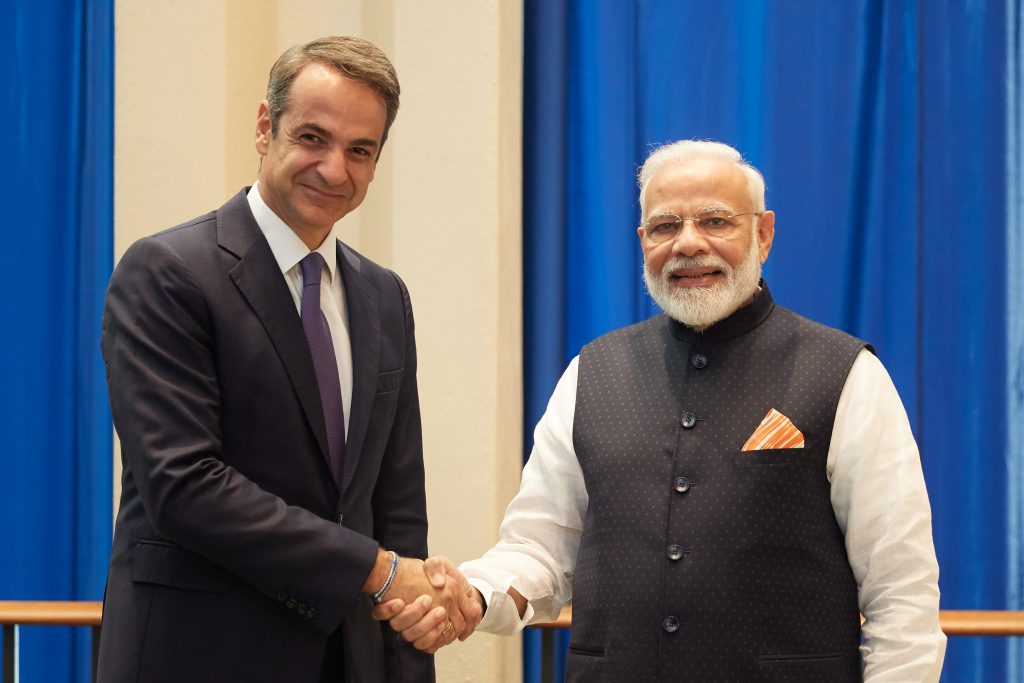


India-Greece relations are rooted in antiquity but diplomatic ties as two modern nations began in 1950. Over the last 76 years, India-Greek ties have been friendly, trouble free and till this day characterized by very close personal ties between our top political leaders. As changes to the post-Second World War order accelerates, both sides have felt the compulsion to build a deeper and more strategic relationship. During the visit of Prime Minister Modi to Greece in August 2023 and the visit of Prime Minister Mitsotakis to India in February 2024, both leaders took the decision to upgrade ties to a strategic partnership and laid out a plan to achieve this goal. Broadly, this has involved a step-by-step upgradation of the existing inter-Governmental dialogue structures to make it ‘fit for purpose’ in a strategic partnership. And it has also involved creating structures to ‘hand hold’ both Indian and Greek business firms who have discovered each others’ markets to enable a strong economic partnership to develop.
The strategic drivers on the Indian side for closer ties with Greece are clear. As a large Indian ocean nation, for whom entry and exit points into and out of the Indian ocean are important, Greece’s geography at the mouth of the Suez Canal is in itself a powerful driver for a strategic relationship. But there is also an idea in India of Greece acting as its gateway into Europe as we build closer ties with a European Union (EU). The challenge presently before both Governments is to find ways to give ‘fullest expression’ to these powerful drivers particularly in the areas of Defense, Security and Trade.
Top Indian defense companies look to partner Greece as it implements its national defense re-industrialization program under its Agenda 2030 and EU rearmament programs. Indian defense firms, particularly in the private sector, have acquired remarkable technical sophistication and industrial scale capacities directly relevant to Greek programs and need to be given a try. Several top Greek companies from logistics, to airlines, banks, tourism, window manufactures and even a coffee-barista retail firm, have already discovered the growing Indian market. Structures like the Indian Chamber of Commerce-SEV and Athens Chamber of Commerce-CII partnerships, established on the initiative of Prime Minister Mitsotakis during his visit to India in 2024, need to be activated to ‘hand hold’ Greek companies successful entry into the Indian market, and of
course hand hold Indian firms in the vice versa direction. The vast pool of skilled manpower available in India and the pressing demand for skilled manpower in Greek industry as it grows and diversifies represents a labor market ready to be birthed. Both governments need to accelerate negotiations on a bilateral agreement that will put in place a robust regulatory framework to ‘de-risk’ the market from the dangers of irregular migration, while at the same time protecting the interests of Greek firms and Indian workers. For quicker results this negotiation has to become an exercise in facilitating labor mobility as a factor of production, and not trying to define legal pathways to migration which is of little interest to either country.
There is a famous saying that “nothing is more powerful than an idea whose time has come”. As India grows and develops itself as an Indian ocean nation…and as it looks to establish a closer relationship with the EU…. and as the world around us changes ever more dramatically and rapidly….. more than ever before the time for an India-Greece strategic partnership has truly arrived. I have no doubt that this will hold even more true in the future, as the IMEEC corridor comes into existence and links India, middle East and Europe into a corridor of peace and prosperity.
*Rudrendra Tandon, Ambassador of India to Greece